The back story
Richard Rogers in London: Lloyd’s, the Dome and buildings that show how they work
Florence, Yale, Team 4 and Paris, then Lloyd’s and the Dome: the architect of inside-out buildings.

Photo Credit
Image courtesy of © Choinowski · CC BY-SA 4.0 via Wikimedia CommonsRichard Rogers made buildings that show you how they work. In London, two visits tell the story: the Lloyd’s Building on Lime Street, which wears its stairs, lifts and ducts on the outside, and the former Millennium Dome at North Greenwich, now The O2, a vast low roof stretched over open space. One packs the machinery round a crowded workplace; the other leaves almost everything inside free to change.
Florence, London, Yale
Rogers was born in Florence on 23 July 1933 and trained in London, at the Architectural Association. In 1961 he and his wife Su went to Yale, he to study architecture on a Fulbright scholarship, she urban planning, and one of his fellow students was a young man from Manchester called Norman Foster. Together they criss-crossed America to see the buildings of Frank Lloyd Wright. “Wright was my first god,” Rogers said.
Team 4, and Paris
Back in England, Rogers, Su, Foster and Wendy Cheeseman formed Team 4, their first practice. Its first significant commission was Creek Vean, a house for Su’s parents; then came the Reliance Controls electronics factory in Swindon. Soon afterwards Team 4 broke up, and in 1967 Rogers and Foster each formed a firm of his own: two of the great careers of modern architecture began at the same drawing board.
In 1971 Rogers took on a new partner, Renzo Piano, and Piano + Rogers won the competition for the Centre Pompidou in Paris, the building that made their names, its pipes and escalators worn on the outside for all to see.

Photo Credit
Image courtesy of © Colin · CC BY-SA 4.0 via Wikimedia CommonsLloyd’s and the Dome
The Lloyd’s Building on Lime Street, completed in 1986, took that idea into the heart of the City: stairs, lifts and ducts on the outside, so that the floors inside could stay open for the insurance market. On the pavement, the gap between the old stone City and the new machinery is the width of a street. Our page on the building tells its story in full.
Two of the great careers of modern architecture began at the same drawing board.
The Millennium Dome, completed in 1999, went the other way: one enormous, low enclosure with room for whatever happened beneath it. Its second life as The O2, with concerts, outlet shops and a climb over the roof, has proved the point. Rogers was made Lord Rogers of Riverside in 1996, won the Pritzker Prize in 2007 and died in 2021.
Our advice: see Lloyd’s on a weekday from Lime Street and Leadenhall Market, when the City is working round it; keep the Dome for an evening, and walk up and over its roof.
Why it's on our list
- Florence to Yale
- Team 4
- Pompidou
- Lloyd’s and the Dome
Location
The map comes from Google Maps, which sets its own cookies once it loads.
More in depth
 The back storyNorman Foster in London and Athens: the Great Court, the Gherkin and Riviera TowerManchester, Yale, a museum roof, a City tower and a green skyscraper on the Athens Riviera.
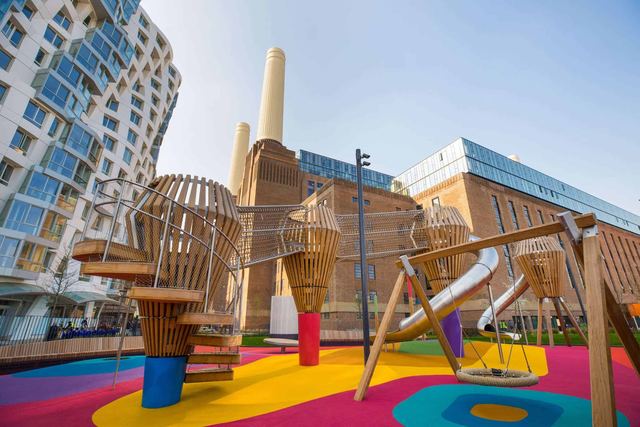 The back storyFrank Gehry in London: Prospect Place at Battersea, and the house that started it allToronto, a chain-link house in Santa Monica, Bilbao, Disney Hall and his first homes in Britain.
 The back storyCurtain up: London’s TheatrelandFrom Drury Lane’s Restoration playhouses to Shaftesbury Avenue: how the West End was made.